Tuesday, 18 September 2012

Basically getting a couple of loads off my chest. A largely aimless and poorly-structured rant about appearance, attitudes and insecurities.


First off: Changing Faces. Because they're good, to say the least.
This is me. A fairly large chin, a couple of spots here and there, largely-uncontrollable hair, good eyes, very skinny but fairly healthy nonetheless. Not exactly a model, but not too bad either. Pretty average overall.

 Take the hand away, though, and we find something strange. A lop-sidedness, and a source of more insecurities than I generally care to make public. I'd be being melodramatic and probably plain wrong if I were to say it's the source of every insecurity I have, but it's nevertheless a constant niggle, a constant factor in how I interact with others, particularly strangers and those I don't know all that well.
Firstly, some background. It's called cystic hygroma; a form of lymphangioma. It's a benign condition affecting only about 1000 people in the UK, in which tiny, lymph-filled sacs concentrate during the embryo's development in the womb and form a harmless, squishy mass which slowly grows as the patient does.
Relative to my size at the time, it used to be far larger than it currently is, but during primary school I underwent surgery to remove some of the bulk, as well as several injections with a chemical to reduce the swelling. The chemical used (called OK432) was known to reduce the swelling right down to almost nothing, but was not declared safe for use in the UK until after I had already had the surgery. Surgery makes it (by my sketchy understanding) far less likely for OK432 to reduce the swelling effectively, and so I was left with a noticeable swelling where I might have had next to none.
The effect of the swelling went further than just the cheek. I briefly wore braces to straighten my teeth, but the constant pressure from the cheek, combined with uncertainty over whether further surgery was to take place, was such that the orthodontists abandoned the work and left my teeth in this crooked state:
They are otherwise completely healthy and fine. No decay at all. Never has been. But they are undoubtedly a negative aspect of my appearance, and contribute to the aforementioned insecurities.
I said a moment ago that my appearance is a constant niggle during social interactions. Call it a slight paranoia. Are they looking at me? Why are they looking at me? Is it the cheek they're focussing on? Was that person mimicking me there? The teeth as well. I'll stop talking. And smiling.
etc, etc...
My sense of humour can be strange at times, and deliberately crude and offensive when I know I can trust people around me not to overreact, but beyond that I don't think I'm a particularly difficult person to get on with. I'm reasonably approachable, I hope, if not very approaching myself ("Oh God, what if I'm just an awkward fifth wheel?"). I can trace back my relative introversion to incidents more than six years ago now, to when I deliberately kept myself from expressing most emotions for a long period of time as a coping strategy for the increasing alienation I was feeling. The result was that I snapped, punched someone and endured a year-long bullying campaign driving me further and further down into self-repression. Although I might be mostly over that now, some scars take a long time to heal, and I remain relatively introverted. Taking the initiative in social situations is hard.
There's no sense denying it, or dodging the issue. I am not, and likely never will be, a particularly good-looking person. I can (and now do) do things to make the best of a bad situation, but I still come out at a distinct disadvantage compared to others where, it seems to me, there shouldn't be one.
Attitudes towards appearance and disfigurement in the UK are better than some parts of the world. From my experiences dealing with people from the US, for example, it's apparent that they have a far more cold and unsympathetic view towards it (their obsession with perfect teeth in particular is astoundingly harsh). But I digress. Despite the UK's comparatively good collective attitude towards the issue, there are still enough cuntbags about to ruin one's day every now and again when I might go somewhere busy (I'm looking at you, sort-of-acquaintance last night who brought on this little ramble here when they though I wasn't looking). Attitudes against that kind of douchebaggery are not on a par with those about racist or homophobic behaviour, where they really ought to be.

Thursday, 6 October 2011

Why I am not a vegetarian

I love eating meat. I really love eating meat. The taste, the texture, the juices that squelch out when you bite into a rare-cooked steak... The slight crunch of the outside of a chicken leg...
You get the picture.

I also acknowledge that my descendants might look back with disgust at the idea that I would consider eating even one animal, let alone the thousands, nay, tens of thousands of fellow thinking beings that have lived miserable lives and been slaughtered, often brutally, for my personal enjoyment.
I even acknowledge that I may become a vegetarian myself. As society progresses culturally, I have no intention of being left behind. We find ourselves shocked by the bigotry of those who live by the societal norms of previous decades, the people who spout racist, xenophobic and homophobic nonsense. The Daily Mail-readers who cry "It's political correctness gone mad!" whenever a straight-thinking person points out how stupid and hate-filled their comments are.
I have a bit of a prediction of my own about the future. I expect that it will be considered unethical across the Western world to be anything but vegetarian. Meat-eaters will become the backwards old bigots of tomorrow. In all honesty, the vegetarians have the moral high ground and us carnivores know it. And if there is one thing recent history has been teaching us, it is that good ideas have a tendency to win out.

So why am I not a vegetarian already? Simply because I enjoy meat too much. Giving up meat would be depriving myself of one of the top ten most pleasurable things in my life (maybe number 8 or 9?). Not gonna happen, I'm afraid. I'm simply too selfish. It's one of the few things I do that I recognise as being morally bankrupt but continue anyway.

I am rather relying on technology here. The day I taste artificial meat that tastes as good as or better than the real thing is the day I turn veggie. Quorn as it is right now simply does not compare. The texture is totally wrong, although the flavour is getting close. It doesn't have a grain. It doesn't have juices. It's just squishy mush that tastes quite a bit (but not quite) like chicken. And don't get me started on veggie burgers. I have tasted few things more vile.
But as production techniques get more and more advanced, I fully expect to see Quorn and similar products become more like the real thing. I would give it ten to fifteen years before a realistic vegetarian chicken can theoretically be produced (although it might cost a lot), and maybe even less time for minced beef. Steak might be a bit more tricky (it has to be juicy, tender, ooze blood and other fluids etc).

In addition to the obvious moral issue of ending the lives of creatures that think, feel pleasure etc there is also the issue of economics. It requires an area of land about ten times larger to rear livestock than it does to grow the same amount of crops. With significant portions of the human population malnourished twinned with exponential population growth, such an attitude towards agricultural land use is simply not sustainable in the long term.

There is perhaps one argument against vegetarianism: The "the animals wouldn't even have been born if we weren't going to eat them" argument. I don't accept that as a reasonable position. An animal never born is an animal that never suffers.

I don't know if you started reading expecting to see a genuine attempt at justifying my meat-eating. Sorry. Not here. It's just tasty and I'm too selfish to even consider the remotest possibility of giving it up any time soon.

Tuesday, 4 October 2011

I Really Aught to Respond...

Aught3, the author of Indoctrinating Freethought last month made a response to my post "Philosolosophy time! Absolute truth, morality, Nazis and God." I've left it long enough. Let's actually address what he has to say.

I'll start off by making a bit of an apology for my original post to which Aught responded. Honestly, it was a bit of a mess. I basically sat down and started typing, with no clear idea of where I was going with it. As a result, it probably came across as a confused rambling with half-formed ideas. Which is, in all honesty, probably fair comment.

I agree with Aught for the first five paragraphs, until he says the following. On quoting what I said about Nazi wrongness being subjective, he says:

"But is this test sufficient? What if we change the topic and consider a flat-Earther? Surely there is a single flat-Earther who considers their position on the shape of the Earth to be justified, or - if not - we can at least agree there is the capacity for someone to consider the flat Earth position justified. According to Nasher’s test this makes the issue of the planet’s shape subjective, but earlier we agreed that this was an objective question. I would submit to Nasher that his central test for subjectivity leads to outcomes that he would reject."


I think the issue lies is a failure of communication on my part. I was not trying to use the question of whether someone can hold an opposing viewpoint as a test for whether something is objective or subjective. Rather, it is closer to a "property" if you like, of subjective viewpoints.
I made the claim that moral viewpoints can only ever be considered opinions, but I never really justified this particular point. I took it (mistakenly, perhaps) as a given.


So let's try and justify it:


I make the claim that moral standpoints are inherently subjective. Whether something is morally right or wrong cannot be determined as an objective fact, but instead varies from one individual to another.

Aught uses the example of "apricots taste better than strawberries" as an example of something subjective. I'll go further. I say that "sugar tastes better than elephant dung" is also subjective. Now, you will be hard pressed to find a single person who enjoys the taste of elephant dung over sugar. But we shouldn't limit ourselves to our species. I'm sure dung beetle larvae might beg to differ, for example. Or an alien species to whom monosaccharides are toxic, perhaps.

In a similar way, I make the claim that moral issues can only ever be subjective in nature. Certainly, we might be hard-pressed to find a human who considers the Nazis morally righteous. But what about, say, an alien species to whom, for whatever reason, the belief that eugenics and cruelty to ones' own kind is right is evolutionarily beneficial? Might not it seem completely natural to them to admire the Nazis? Who is to say they are in the wrong? What standards do we use as a frame of reference? Our own?

Okay, now let's bring this a little closer to home (ie: the real world). It is a fact that variation occurs between humans. This is partly due to genetics and partly due to the effects of our environment. I am doubtful that there are any humans alive who possess sufficiently different genetics to make them excessively prone to bigotry. But there are certainly humans exposed to environmental factors capable of this. A man who lives in poverty whilst many people of a certain group live well might be inclined towards bigotry against that group of people, even when many of them live in poverty alongside him.

The amount of change to a person's psychology that can be brought about by environmental factors is so enormous that no objective frame of reference can be used against which we can compare their morality. In the case of the Nazis, a person brought up in the modern world is unlikely to be exposed to factors that make them susceptible to thinking they were righteous. But there are of course still some neo-Nazis. And if we go back in time, we see people who were increasingly more bigoted than us. Even listening to old people, brought up in a different environment to my own, I am sometimes shocked by the xenophobic or homophobic bigotry they come out with. But of course, they don't see themselves as immoral. Might not our descendants think the same of even the most moral people alive today?


So, to sum it all up:

A viewpoint can be objectively true or false if there is a clear, immovable frame of reference to which we can compare and contrast the viewpoint.

That the Earth is round is objectively true because there is a clear, immovable frame of reference to compare it to. Namely, reality. We can check. If a flat-Earther checks, they will still see a round Earth, even if they really don't want to.
For a moral view, there is no known absolute frame of reference. Perhaps in our pursuit of science, we will find one. Perhaps the moral objectivists were right all along. Perhaps (disheartening though that would be to us) humans are ourselves an objectively immoral species. But for now, in the absence of any evidence for an absolute frame of reference, I am inclined to believe (mind-bendingly, perhaps) that moral relativism is true.


I think I've made my points clear. But I may have miscommunicated some parts. I guess we'll find out.

Thursday, 15 September 2011

Up Next...

Things are certainly starting to heat up a bit. In just three days I will be going to university and my schedule is pretty much full until then. Once there, I will of course be taking part in various activities associated with Freshers' Fortnight (yes, fortnight) and so it may be a while before I can write anything substantial on this blog.

What I will be doing, when I get a chance, is addressing a response to my last post by Aught3 on his blog, Indoctrinating Freethought. His response can be found here.

But yeah, this place may briefly become barren-not that there's that much activity here anyway...

Tuesday, 30 August 2011

Philosolosophy time! Absolute truth, morality, Nazis and God

Something that frequently annoys me is that staunchly religious (read: usually evangelical) apologists tend to argue that there are absolute moral values, that something is either objectively wrong, objectively good or objectively morally neutral. This is flawed, for reasons I will address in a moment. But something else that irritates me is that they call it "absolute/universal truth".

I feel that they consistently fail to make a distinction between different types of "truth". Some things are absolutely, objectively true. That the Earth is round is an example of this kind of truth. I acknowledge that. But other things are seen differently from person to person. That stealing is wrong is an example of this. Care should be taken to distinguish one type of "truth" from the other.

I hold that moral questions should not be considered to hold absolute answers. I hold that no answers to moral questions should be considered "truth" in any way. Rather, they should be considered and referred to as "opinions".

Let's use emotionally charged examples to show what I mean.
Is murder wrong? The obvious answer is "yes"-at least, it is in most circumstances. The question is incomplete. There still might be circumstances in which murder is objectively good or objectively bad. So let's use a better example:

Were the Nazis justified in the systematic extermination of six million Jews?
Obviously, your answer is "no". I share your sentiments. I consider the Holocaust to be one of the worst crimes committed in human history. If you do not feel the same way, I invite you to jump off a skyscraper and rid the rest of the world of your barbaric views.
And yet, I still hold that the question does not have an objective answer. If that sounds appalling then allow me to explain myself.
Did the Nazis themselves think they were justified? If the answer is "yes", if even a single Nazi considered the holocaust justified, then the answer to this moral question is subjective. In fact, all it takes is the capacity for someone to consider it justified and it becomes subjective. All of morality is like this. One cannot experiment on a moral question and find it true or false. It is open to variation from one person to another. All moral truths are in fact just opinions.

But the other kind of truth is objective. Scientific truth can be tested, observed and determined one way or the other. Probably. Scientists are always careful that nothing should be considered definitely true. But not because it is a matter of opinion. Opinion does not affect how true something is in science. But there is always the chance that the scientists have got it objectively wrong, or at least, objectively not quite right.

The Earth is shaped like a slightly squashed sphere. That is a fact. It does not matter if you believe the Earth is flat. A flat-Earther cannot walk walk to the edge of the world, not matter how hard they try.
The Earth is orbiting the Sun. That is also a fact (although actually, the Sun also orbits the Earth, but the Earth is so small that the Sun just wobbles a bit as the Earth zooms round once a year). It doesn't matter if you are a die-hard geocentrist.
The universe is probably about 13.72 billion years old. That is once again a fact. It will not be 6000 years old just because you might be a creationist.

Et cetera, et cetera.

Does God exist? Is it the god of the Bible (definitely not, I'm afraid) or some being that bears some aspects of the Biblical God? Or is it a Deist god, that made the universe, then let it do its own thing?
Whatever the case, I hold that this is a scientific question. Either God exists or he doesn't. Either he/she/it is like this, or like that. There is no middle ground. Claiming it as a theological question is just a way to dodge the issue. Trying to prove it one way or the other just by logic is fallacious.
We must do the scientific thing. When a scientist wants an answer, they look for positive evidence. They experiment. A being that can create Quasars and galaxies should leave a trace of its existence. If there is no physical, tangible evidence, then one should dismiss the hypothesis and formulate a new one.
There is no physical, tangible evidence for the existence of any kind of god, spirit, higher power or life force. The religious should, in my opinion, move on.

Wednesday, 10 August 2011

Two exchanges between myself and others on Facebook

Posted on the off-chance some people might find it interesting:

On the Facebook group "Smashing up your own city because you have the IQ of a ham sandwich" someone called Wayne Lush posted the following:

Wayne Lush: "Vote BNP this stuff won't happen"

My response was:

Me: "What, because the BNP would have sent in the SS by now and gunned the rioters down? Because they would have sent them to concentration camps? Fucktarded though the rioters may be, the BNP in power is by far the greater of the two evils."


I then received a private message from someone else called Mary Kingdon (not "Kingdom"):

Mary Kingdon: "Hey, I don't like this comment. Please remove it. [she then posted a copy-paste of my comment] Link to content:
http://www.facebook.com/permalink.php?story_fbid=175989085806344&id=175743665830886"

'Ooh!' I thought. 'A chance to argue with a stranger on the internet! I must respond.'

Me: "With all due respect, I wouldn't take it down even if the Prime Minister, the Dalai Lama and the Archbishop of Canterbury said together that they were offended. One right we do not have is the right to not be offended.

You could perhaps persuade me that my comment is inappropriate or disproportionate-in which case I will still leave it up for historical purposes, but add a disclaimer in the same comment section rather than take it down and pretend I never said it.

In any case, I can't see why a reasonable individual would dislike my comment. It is an attack on both the stupidity of the protesters and the policies of a far-right, neo-Nazi political party."

Her response then baffled me slightly:

Mary Kingdon: "Bullshit. I have been offended by your arrogant and childish comments. I abhor your nazi tendencies as would all right thinking Brits. You just jumped on a bandwagon and followed the pack mentallity which is what the youths were doing. Because you lack respect for others in the same way. Oh and don't waste time replying because I will have blocked you from doing this."

So I replied, with no real idea what the fuck they were talking about at this point:

Me: "Nevertheless, I shall reply, for there is some chance you shall read what I have to say.
I feel you may not have actually read what I said. What "nazi tendencies" did I exhibit? I am the one opposing the BNP. The BNP are the ones with Nazi tendencies.
I am not sure what you mean by "pack mentality". When I typed my original comment, it appeared to my screen that there were no other comments below. I did not know that others would post.
In what way do I "lack respect for others"?"

Saturday, 23 July 2011

On the Norwegian Terrorist Attacks, Fundamentalism and Racism

A long-winded title for a blog post, perhaps. But all three topics are linked.

Firstly, unless you have been living under a rock at the bottom of a lake since yesterday afternoon, you will no doubt be aware that two terrorist attacks were carried out yesterday (22nd July 2011) in Norway.
The first was a bomb attack in the capital, Oslo. Current reports indicate that this killed seven people.
The second attack was far more shocking. A gunman disguised himself as a police officer and visited an island several miles away from the capital which was hosting a youth camp organised by the ruling political party. In the confusion following the bomb in Oslo, he was allowed access to the camp. He then opened fire on the campers, killing at least 84 people in the half hour before he was arrested.
This is stunning. A bombing is in itself a brutal, vicious thing to do, but gunning down 84 defenceless, innocent people is the action of a person who barely deserves the title "human." To carry out such acts, the gunman must have been completely level-headed and utterly callous.

Despite initial speculations of an attack by Al Qaeda or Gaddafi, the gunman was in fact a Christian fundamentalist.

Interestingly, Christianity was trending this morning on Twitter. Let's see what people on Twitter had to say on the subject:

"The murderer in Norway is not a Christian, and these evil actions have nothing to do with Christianity."
"He doesn't represent Christianity."
"That isn't fundamental Christianity. Or even mental Christianity. It's just insanity."

Et cetera, et cetera...

Of course these acts aren't representative of Christianity. Of course this man is an exception to the rule. But he is a Christian. That is undeniable. Trying to deny that is like trying to deny that he is Norwegian because most Norwegians don't do that sort of thing.
Religious fundamentalism is a backwards and thoroughly ridiculous stance that has thankfully almost died out in the West (with the notable exception of the United States).

I expect, then, that we'll see the Daily Mail on Monday foaming at the mouth about how Christianity is incompatible with modern democracy and that churches should be closed down. After all, didn't they say just that after the 9/11 and 7/7 attacks?
Ah, my mistake. Most Christians in this country have the same colour skin as us. How silly of me.

Seriously, though, there is a problem. All too often people attack Islam as backwards, medieval or barbaric without taking into consideration that precisely the same thing could be said of Christianity.
Ah, you might think, but what about all the pictures we see of Muslims holding up signs reading "ISLAM WILL DOMINATE THE WORLD" and "BEHEAD THOSE WHO INSULT ISLAM"? Isn't that evidence that Islam is more inherently fundamentalist than Christianity?

No, it is not. Hands up who has wandered around town, or been on public transport and come across a fundamentalist preacher telling indifferent passers-by to accept Christ into their hearts or suffer eternally. Now hands up who has seen Muslim preachers doing the same for Islam. One at the back. Thought so.

Then I ask: why we do not see pictures of these Christian preachers plastered just as frequently over the pages of the Daily Mail and The Sun? I would hazard a guess that it can be summed up in one word:

Racism.

Thursday, 14 July 2011

Priorities

Came back home on Sunday morning after the Year 13 prom (which was good, although I have very little recollection of the after-party). After having a shower, I went downstairs to find my mother in the kitchen. She asked me if I "picked up any girls". The answer was no. (I'm not suave or self-confident enough to simply say "Hey babe, fancy a dance?" If you know what my voice sounds like and what I look like, you'll know immediately just how horrifyingly, ridiculously awkward and utterly unromantic that would be coming from me.)

Later on, when I saw Dad, his first question was not along those lines. His first concern was how drunk I got. He was pleased on that account.

I found this mildly amusing, at any rate...

Saturday, 9 July 2011

Goodbye Space Shuttle

The Space Shuttle Atlantis took off yesterday for the last time. Never again will humans be taken into space by those ships. I won't say "good riddance" because the Shuttles have contributed to countless discoveries over the last few decades. But I am glad to see the back of them.

The Cold War-era space race was driven by competition between the USA and USSR. Each wanted to show that they could outmatch the other's technology, because mastery of space meant mastery in the event of a nuclear war. A rocket that could take men into orbit could easily bring nuclear weapons crashing down on cities.

Then, suddenly, the Soviets simply gave up the fight. They made no attempts to get men to Mars or establish a base on the Moon. The Americans relaxed and the future of space exploration was held back for decades. No human has set foot on another world since 1972.

But another space race has been gearing up, largely behind the scenes. This time between private companies. As happened with aeroplanes in the postwar period, competition may be able to drive down costs significantly, especially with new and more efficient rockets. I strongly doubt space flight will be affordable for normal people until an orbital elevator is constructed, but we might at least be able to see government-owned bases spring up on the Moon this side of 2030 and space hotels in orbit for the rich and famous before 2020.

Monday, 4 July 2011

50 Things

Shit.
I have nothing original to write about, but think I should do something more worthwhile than arguing with morons on the internet, as I have been the past half hour. Therefore, I am going to write down 50 different facts about me, on the off-chance that someone will find at least some part of it interesting.

  1. My full name is Thomas Alexander Nash
  2. I was born with a small hole in my brain caused by a blood clot in the womb.
  3. Perhaps as a result of this, my dexterousness is all fucked-up. I write left-handed, drink right-handed, shoot a gun left-handed but shoot a bow right-handed etc
  4. I was born with a hole from one side of my heart to the other, but this has since closed up.
  5. I was born with a condition known as Cystic Hygroma, which affects about 1 in 60,000 people. Basically, I have a large cluster of lymph nodes in my right cheek, making it appear swollen.
  6. I have had several operations to reduce the swelling. If you think it looks bulky now, you should see pictures of me as a baby.
  7. My right leg is slightly shorter than my left. This gives me a slightly strange gait. I walk heel-toe on my left foot but toe-heel on my right. But if I walk quickly, both feet go toe-heel.
  8. I am partially colourblind. I can see in colour, but I can't tell when bananas are ripe, amongst other things.
  9. I nevertheless have perfect 20:20 vision.
  10. I am an agnostic, ignostic atheist humanist. I do not believe in any gods, but consider the assertion that there are definitely no gods unscientific.

  11. I find it impossible to choose what to believe. I don't know if everyone is like this, but often people talk about "wanting to believe" something. I can't do this. It's either true or it's not, and whether I think it is good or bad has no bearing on the truth of a statement.

  12. I have had two experiences that could be called "numinous", that is to say, "religious" but not as a result of religion. The first came when driving through the Australian outback at night. I looked up and saw the incredible, vast cloud of the Milky Way galaxy above my head. For a brief period of time I was able to comprehend as I had never done just how enormous the galaxy was. It brought tears to my eyes.

  13. On a less serious note, my favourite food is normally pepperoni pizza.
  14. The perfect pizza would be barbecue and stuffed-crust, and have pepperoni, ham, bacon, minced beef, chicken and possibly duck as toppings.
  15. I consider minstrels to be the nicest chocolate cheaply available.
  16. I am single.
  17. I am heterosexual.
  18. I am, it would seem, inept with regard to relationships.
  19. I had a very quiet emotional breakdown between the ages of 14 and 15.
  20. I'm a complete nerd/geek. There's no point denying it or taking offence at the term.

  21. I have a phobia of needles resulting from having a drip left in my hand long after the anaesthetic had worn off when I was about 7 or 8, allowing me to feel the pain of it being in there.

  22. The last time I went for a routine injection, I was voluntarily sedated beforehand with (prescribed) diazepam.
  23. Diazepam felt like being drunk, only without any urge to carry out "good ideas".
  24. I have never smoked anything.

  25. I once wore a brace, but any changes made by the brace were being pushed back by my cheek, so the decision was made to stop wearing it. Hence I have fairly crooked teeth.
  26. I have one filling. Not because that tooth had a cavity, but because it came out of the gum already chipped. Typical.

  27. I am a moderator on an online forum.
  28. I was also a "super user" (moderator) on another forum which then died.
  29. I have been involved for many years with a charity called Changing Faces. No prizes are awarded for guessing why we first got in touch.
  30. I was once on posters to increase publicity for Changing Faces.
  31. I was once featured in a photo exhibition at the National Portrait Gallery in Manchester.

  32. There is a reasonable chance that I will also be briefly shown in a BBC3 series soon. Not as a subject, but simply because I was on the same activity day as one of the people who is a subject of one of the episodes.
  33. I can flare my nostrils.
  34. I have a very high metabolism, but low blood pressure. The result is that I can eat and not get fat, and I have a lower risk of heart disease.
  35. I am a casual Lifeguard at a local sports centre. I can work if and when I want, and the pay is amongst the best available for someone my age.
  36. The most action I have seen in my job is a grazed knee. The exciting stuff happens precisely when I'm not there, which suits me just fine.
  37. I get an unparalleled level of respect when I'm wearing the uniform. I can make douchebags stop their douchebaggery with a whistle-blast or a shake of my head. Maybe they fear me slightly because I can have them removed from the centre. POWER! Muahahaha!
  38. I read two webcomics regularly. Yeah...
  39. Probably my favourite all-time game is Rome: Total War. I use mods (modifications) to the game, as the original has long ago lost its appeal to me. The replay value with mods is almost unparalleled.
  40. I was born in Pembury, Kent.
  41. I have a strange accent. My family moved to East Yorkshire when I was three, so I've picked up quite a few local intonations. But at home everyone still speaks with more southern accents. So my "o"s are quite strongly pronounced, amongst other things.
  42. I dislike the sound of my own voice. If I have to listen to it, I try not to for long.
  43. Ideally, I would be almost carnivorous. Meat tastes so much nicer than vegetables. But I have to take into consideration both health and the fact that chocolate and breakfast cereals are not meat.
  44. I've effectively given up on getting my driving license this side of university. I tried to learn, but over a year later, my instructor was taking me round the same bloody roundabouts each week. Not a single manoeuvre or anything. I could almost do those roundabouts with my eyes closed. So I've since stopped having lessons.
  45. I resat the first year of Sixth Form. I got a D, two E's and a U the first time round, as opposed to three C's and a D the second time.
  46. I'm hoping to study biology Derby University this September. Failing that, I'll go to Salford which, despite its low reputation, has fairly strong biology.
  47. If I choose, I can probably exercise complete control over at least two people through blackmail.
  48. As long as the situation is not emotionally charged, I can be a fluent liar. Which is very useful.
  49. The most fun I've ever had doing an activity was paintballing. If I had someone to go with, I would go as often as possible.

  50. I tend to be optimistic. I have yet to come up against a single event that has changed my life irrevocably for the worse. In fact, the worst disaster I have met (see 45) has actually turned out to be a blessing in disguise. It granted me the extra time and support (intentionally and accidentally) to mature emotionally to the point where I actually feel ready to flee the nest.

Tuesday, 21 June 2011

Philip Davies and Minimum Wage for Disabled People

Earlier this week in Parliament, one Philip Davies argued that people with disabilities should be "allowed" to work for less than minimum wage. He argued that an employer is more likely to employ a person who is not disabled and that allowing disabled people to work below minimum wage would be a good way to prevent employers discriminating against disabled people.

I strongly disagree. Allowing such a thing would have precisely the opposite effect. Granted, disabled people might (and I stress the term) be able to find work more easily. But it would still allow discrimination in far too easily. If an employer knows that the law allows disabled people to work for less, they could very easily make a little pay cut that lowers the wages of disabled people in their company whilst still remaining within the law. It compels disabled people to accept the idea of being payed less and encourages discrimination.

Rather than tackling the issue in this way, Mr Davies should have made it his priority to tackle the attitude that would drive employers to hire a non-disabled person over a disabled. An employer that puts profits above people holds an utterly morally bankrupt position. The law should acknowledge this and counter it, not encourage it.

Thursday, 9 June 2011

The Case For A Federal Europe

Tony Blair said yesterday in an interview with The Times that he believes the EU needs an elected president. The editor of The Times and many other people disagree with Blair, saying that such a move is a step on the path towards a federal Europe.
I agree with Mr Blair. In fact, I will go further. The European Union should, in my opinion, become a federal nation, made up of the current member states and willing to accept more members into the fold. The current member states should retain local governance in much the same way that the states of the USA do, but ultimate power should rest with a federal government in Brussels (or even shifting location every few years, if that will make people happier). The military forces of the EU should be shared and no single state should be able to go to war without the backing of Brussels.

There are several reasons why I believe this would be a wise move:
  1. In a word: China. China's economy is now the fastest-growing in the world. In the next few years it is expected to overtake the US. If the European nations are to avoid becoming insignificant on the world stage, they simply must work together for the common good.
  2. Economics. Greece, Spain and Ireland's economies have been on the back foot for over a year now. Without sufficient external funding, their recoveries will be slow. The same goes for the UK, albeit on a smaller scale. While it is fairly easy for an individual, small country to collapse, it is far more difficult to bring down a giant such as a united Europe would be. With money flowing freely to patch up weaknesses in the economy across Europe, deficits would likely be reduced dramatically overall in future recessions.
  3. Military. Under the current arrangement, each European nation trains and upkeeps its own military forces, including nuclear weapons. Under a united Europe, with only one, shared military, the EU could have a military consisting of 200,000 troops and 300 warheads. That would be plenty to deal with any military threat, and would barely make a dent in the European economy. This would free up hundreds of billions of dollars (or Euros, rather) for...
  4. ...science funding and education. With a United Europe, what with the stronger economy and spare money from the reduced military etc, more funds would be available which could transform Europe and the world. Japan and the US currently lead the world in technology, but this doesn't have to be the case. A united Europe could pour hundreds of billions of dollars worth into science and education. Some European nations already have the best education systems in the world. Consider how much that lead could be improved.
    And then on the science front, Europe could single-handedly accelerate the rate of expansion of human knowledge massively. The European Space Agency, if Europe united in the next few years, could have men on Mars and bases on the Moon long before the Americans or Chinese.

Think for a moment just how utterly all this would change the world stage. A United Europe would be the richest nation in the world. Several members of the EU are already part of the G8. If their resources were pooled, the USA, China and Russia-currently the "big three"-would be dwarfed by the EU. The standard of living and quality of life for people in Europe could increase to a point that we would consider almost utopian.

Thursday, 2 June 2011

Pantheism-Possibly a More Applicable Term?

This is the sort of thing I think about after I lose the will to revise further during a day. I'm sure I could be spending my time more productively than this, but here I am.

It's possible that Pantheism might be a more specific and applicable term for the belief system I hold than atheism or even agnostic atheism. I've never used the term "God" to describe the universe like Hawking and Einstein, but I certainly hold a sort of reverence for the universe and have, as I've mentioned in previous entries, had what might be called numinous experiences induced simply by natural wonder.

I do not believe the universe is itself some kind of intelligent entity. There is no positive evidence for it. I do not believe the universe has some conscious purpose or was brought into being through a conscious act. There is no positive evidence for it. I do not believe in any kind of supernatural forces or substances whatsoever, as there is no positive evidence for them. I am a rationalist first, and everything else follows from that. So if I am a pantheist, I'm a thoroughly naturalistic one.

This is a very difficult distinction to get my head around.

Thursday, 26 May 2011

And on a more light-hearted note...

"Hello?"

"Hello, I am Andrew [or Paul? it was a generic English-sounding name] calling from [something] research. May I speak to Mr Nash please."

"As Sab'yn wal Jau?"

"Is Mr Nash available?"

"Safot softim bi'Quarthadast."

"Are you Mr Nash?"

"Inama nishuf al a sadarr. Eyann zaratha zarati. Kali bakka a tishuf a hett. Al a hudad alman dali."

"....
Sorry for wasting your time, sir."

[click. dooooooooooooooooo]


Damn cold callers. But they don't have a response to ancient or fictional languages.

Wednesday, 25 May 2011

Reflections on 8 Years

Okay, a personal post. Not particularly interesting to many people I imagine. In fact, this is perhaps more for myself than the entertainment or enjoyment of any reader.

Tomorrow (Friday 27th May 2011) marks the end of 8 years of Secondary Education. There are still exams to sit, but after tomorrow I will never have a true lesson again.

8 years. Let's take a look back.

September 2003. I, as an 11 year old, started as a Year 7 at South Hunsley school. I made other friends reasonably quickly and sufficiently strongly. This was punctuated by hellish trips on the bus every other morning. Overall rating: meh.

Year 8. A good year. I had firm friends. Bullying issues evaporated. I had good teachers, did well and generally enjoyed myself.

Year 9. A "meh" year. The system in the school meant that we were now divided into groups from all around the year. I was largely cut off from some friends except during lunchtimes. Did well in subjects but in fact found Science painfully slow-I knew literally everything they taught us already from my own casual interests.

Year 10. Cracks appeared. Some friends and acquaintances started behaving in less-friendly ways. A few did 180-degree turns and became openly hostile. Though this was punctuated by mini-fame brought by making a two-second long clip satirising a teacher (Bradsheep), the overall atmosphere came to a head in June or July with me snapping and punching one Adam Medforth in the head. Bad times followed.

Year 11. Near-ceaseless bullying campaigns throughout the year. Though I started the year predicted A*-B grades at GCSE, this slipped and my actual results ended up as 4 Bs and 6 Cs. I learned a useful but ultimately devastating method for dealing with the stress. I completely shut off emotions altogether except for at a few moments every day, when I allowed good feelings to emerge whilst still forcing negative ideas down. I became almost incapable of articulating myself and ended up having a very quiet emotional breakdown about March-April 2008 sort of time. Eventually one teacher did notice my decreasing drive and notified the head of year who coaxed me into letting it all out. The bullying ceased, but the paranoia I had picked up remained.

Year 12 (round 1). Though emotionally drained by the previous year, I nevertheless managed to get something at least resembling enjoyment out of this year. Except in Chemistry, which both piled work on and contained Adam Medforth in the class. Guess which subject I came out with a "U" in?
Year 12 was a crushing disaster. I came out with a D, two Es and a U. So I did it again.

Year 12 (round 2). I started again. Though it was a far better year than had been experienced the last 3 years, I nevertheless made the mistake of not making more of an effort to socialise with the people in my classes. I chose to hang around with people from my age year. Any kind of a social life simply did not exist.

Year 13. Probably the best year since year 8. My paranoia has evaporated. Whatever happens, I am effectively guaranteed a place at university. I have a large group to be around at lunchtimes. And though I'm perhaps still not the most social of people, I nevertheless get out more than I did the last 3 years. In terms of emotional recovery I certainly owe more than might be suspected to various people.

Although I enjoy this specific year, I will be very glad to see the back of secondary education.

Friday, 20 May 2011

On Male Infant Circumcision

Ooh, a controversial topic, this.
Male infant circumcision when there is no immediate medical requirement is, to my mind, a barbaric practice; a relic from the bronze age that has no place in the 21st century. I will not say and do not believe that people who circumcise their child are barbaric. Rather, they are woefully misinformed, misled, or in some cases didn't do adequate research into the issue before making the decision to have their son's foreskin removed. We are so used to the idea of male circumcision that we inadvertently trivialise it and don't see it as a big enough issue.

Here is a basic overview: male circumcision removes 15 square centimetres of the single most sensitive organ in the body. According to every major study (to which I will be happy to link on request) the sensation of pleasure during orgasm for circumcised males is dramatically reduced. The foreskin contains the largest concentration of sensory nerve endings found in the body (between 10000 and 20000 per square centimetre).

There are, however, health benefits to circumcision. Numerous studies have shown that circumcised men have a slightly reduced chance of contracting HIV. The HIV uses certain cells in the foreskin as binding sites to infect the host. Also, the many folds in the foreskin allow the virus to linger on the penis, increasing the chance of transmission. Naturally, however, there is no adequate substitute for using a condom.
Circumcision also slightly reduces the chances of urinary tract infection, as the foreskin can trap dirt and debris which can introduce infection-causing micro-organisms. Simply spending a couple of seconds cleaning the area in the shower all but removes the additional risk.

Male circumcision is not on a par with female genital mutilation. Female genital cutting usually involves removing the clitoris and clitoral hood. The closest approximation for a male would be to remove the foreskin as well as the glans. If any males reading this winced at the idea, they will understand why female genital mutilation is internationally illegal.
That said, the closest approximation to male circumcision is the removal of only the clitoral hood. Women who undergo this procedure (also internationally illegal) claim a loss of sensation, but still come to orgasm with the same frequency. Bear in mind that the removal of the clitoral hood comes with its own health benefits that almost mirror those for males circumcision There is, shockingly, a pro-female circumcision crowd who frequently cite such findings. In fact, some of them go so far as to claim it is sexist to allow males the medical benefits but not females.

This blog post is not intended to in any way trivialise the barbaric practice of female genital mutilation. I do not and would never advocate the legalisation of such a barbaric practice. Rather, I am advocating that male circumcision be made illegal. I hope that within my lifetime, many countries will go down that road as public awareness increases.

Comments are-naturally-free and anonymous.

Wednesday, 18 May 2011

The Most Important Phrase In the World

Every war, every instance of bigotry, every act of douchebaggery ever carried out. All of them could have been prevented with a simple phrase. The phrase must not be spoken spitefully or it loses its effect. It must also be listened to and taken on board.

The phrase is this:

"Get over yourself."

Rivers of blood might not have been spilled, had those three words only been spoken to the right people.
"Germany will rule the world!" Hitler might have cried. "Kill the Jews! Butcher the Gypsies! The Aryan race is superior!"
"Get over yourself!" would be the response. "Germany's alright, but it's not that good. You're just a cunt!"

"I am infallible!" the first Pope might have cried. "God speaks through me! Believe or be damned!"
"Get over yourself!" would be the response. "You're not that interesting to talk to! Go back to you child porn stash!"

"I will destroy you!" might some forgotten king have said.
"I will destroy you!" might some other forgotten king have said.
"Fucking get over yourselves!" the response would cry out, clear and loud. "Do you think your descendants will give a flying fuck about your petty squabbles? Do you think, oh great rulers, that your very names will be remembered, thousands of years from now? Your puny realms will crumble into dust. Not a trace of your ever having existed will remain. Be friends. Share."

And would any of them ever listen. Of course not. But if they had, we could be exploring the galaxy by now.

Monday, 25 April 2011

Is This Not Enough?


Some people see a star and believe it has some effect on their future.
Some people see extraordinary events and believe it happened for their benefit. Even if that benefit is only as small as giving them something pretty to look at.
Some people are told how big the universe is, how small they are and get depressed and frightened. They would rather be important.

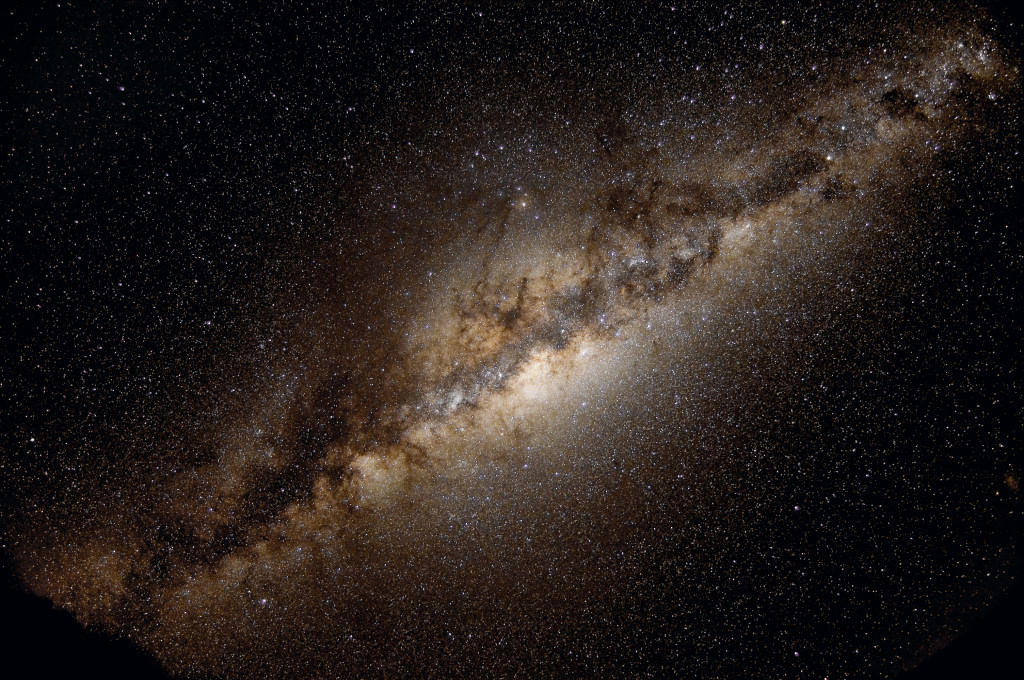
There is no need for this. Reality is a wonderful place and is made all the more wonderful by understanding it. I know that when I stand outside at night, over 300 billion stars are bathing me in their faint light. I have seen the Milky Way without light pollution, seen the immense dust lanes blot out the intensity of the galactic core, seen it for what it is. An immense disc, turning just once in 250 million years. Absolutely, staggeringly huge beyond any comprehension. The image at the top of this post is what you actually see.

The Galaxy is immense. But it is itself only one of several hundred billion galaxies. These galaxies pull each other together. They form clusters. And these clusters form threads and filaments to produce one incomparably huge structure-the universe.

Many people know this. But to comprehend it is something else entirely. No one does this. Not all the time, at any rate. I have perhaps managed it twice. The first time was in Australia, when I first saw the Galaxy. It really hits you like a mental brick wall. It is a spiritual experience, but I at least did not feel it actually came from some spirit.

So many people look at reality and ask "Is this it? Is there nothing more? It's alright, but it's not that good, is it?" So they create stories and fictions around it. They desecrate reality with their childish daydreams and imaginings, when they could be getting so much more by making the effort to understand and comprehend.

Yes, this is it. It is reality. What more could you fucking want?

Friday, 22 April 2011

Monomoron-a new concept

The term "moron" is thrown around a lot. Mainly at stupid people, because they deserve it. But what about people who are actually really intelligent, but hold the occasional stupid belief? For example, a creationist doctor, or an astrology-believing scientist? Or a neo-Nazi rationalist? Or a homophobic psychologist?

I have decided to call these people monomorons. They are reasonable, sensible people who also hold batshit crazy or fucktarded views. Everyone knows several. A lot of people are one themselves, but might not recognise it. I might be one, but the nature of monomoronicism means that I could never tell unless it was pointed out to me. I would hope, however, that I would at least be able to self-rectify such an irrationality.

Friday, 15 April 2011

A Good Book That You Should Read

It's called Foundation.
It's science fiction, but stay with me here. Now I am well aware that science fiction isn't everyone's cup of tea. I mean, when you think of science fiction you probably think Star Trek and similar. Hell, I don't much like Star Trek. But Foundation is a classic to rival any book you care to mention, scifi or not.
It's set approximately 23,000 years in the future, so far ahead that civilisation has forgotten which world was the original cradle of humanity. Humans have colonised millions of star systems across the entire galaxy.
There are no aliens in Foundation. The story is set in the future, but it doesn't focus on the fact that it is the future. There are references to technology, but the technology rarely if ever actually plays a key part in the stories. The science fiction setting is basically just a way for the author to tell any story he likes, which is why it might appeal to a reader with little to no interest in science fiction.

It starts off on the capital world of the Galactic Empire in the last years before visible cracks start to show themselves in society. Although all appears well on the surface, the Empire and galaxy have in fact been in subtle decline for centuries. Scientific research has effectively ground to a halt across the galaxy and corruption is rife.
A group of about a hundred thousand people have been developing a science known as "Psychohistory" which basically combines psychology and mathematics to predict how large groups of humans are likely to behave. Under the leadership of genius Hari Seldon, they are able to plot the course of history and see that Trantor, the Galactic Capital, will lie in ruins within five hundred years.
The psychohistorians' findings are controversial, and they manage to engineer the Empire into exiling 70,000 of them to a remote world called Terminus, where they will compile an Encyclopaedia to preserve knowledge through the coming dark ages. The organisation is named the "Encyclopaedia Foundation number one" (later shortened to just "The Foundation"). The overarching aim is that the Foundation will be subtly guided through a series of crises over 1000 years, eventually emerging as the seed for a second, greater, more compassionate and more powerful Galactic Empire.
The story is told through a series of short stories, spanning 200 years, from the beginning of the end for the Empire, through to the emergence of The Foundation as a major galactic power, ending just over a generation before the first conflict between The Foundation and the remnants of the Empire.

Read it. You won't regret it, whether you normally like science fiction or not. Foundation is one of the literary greats and has played a crucial role in influencing our culture. Star Wars and many other influential cultural works were directly inspired by Foundation.